Water is humanity’s most fundamental security issue

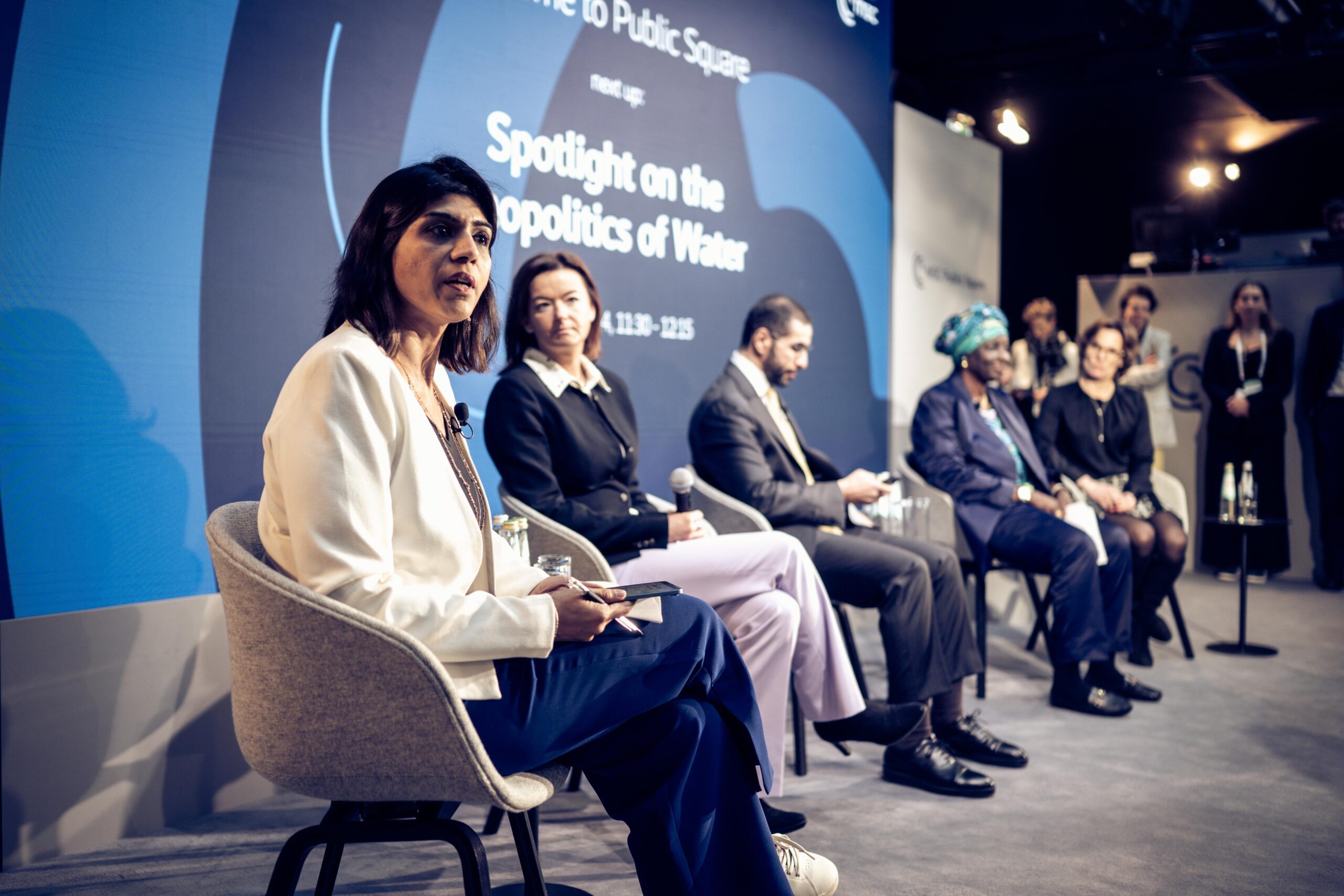
When international leaders and experts gather in Munich this week, the headlines will be predictable: geopolitical power shifts and military prowess will attract attention. Hardly anyone will be talking about a crisis that goes deeper than all of this – and yet determines global stability: water.
But the topic belongs right at the heart of the agenda at the Munich Security Conference. Because without water, there is no security. Agriculture is responsible for around 70% of the world’s freshwater withdrawals, making water a crucial bottleneck for global nutrition. Climate change is dramatically exacerbating the situation: For every degree Celsius of warming, yields of key crops fall by up to ten percent. In combination with a growing hunger for energy and a rising world population, the risks are increasing rapidly.
The Arab Spring is a lesson in this. It is often seen as an uprising against corruption – but at its core, it also has to do with water scarcity. Between 2006 and 2010, Syria experienced the worst drought in its history, while Egypt struggled with extreme heat and unpredictable rainfall. At the same time, global drought-related crop failures drove up food prices. In 2011, the pent-up tensions initially erupted into protests against rising bread prices – and eventually escalated into revolutions. The importance of water security goes far beyond agriculture.
For decades, water has been politicized and instrumentalized by governments and non-state actors. In April 2025, India suspended the Indus Water Treaty following a terrorist attack, creating a legal vacuum with only two options: to ignore the rules and regulations, or to renegotiate them and adapt them to today’s realities such as climate impacts. The dimensions are enormous: the Indus Basin supplies over 300 million people and Pakistan obtains around 80% of its surface water from the treaty. At the same time, the glaciers in the Hindu Kush Himalayas are melting faster than ever before, threatening agricultural production throughout the basin due to flooding and water shortages. Climate change is undermining proven development models, which is why countries like India and Pakistan, as well as other states with shared water resources, need to see water much more as a strategic security factor.
By understanding the link between water and human and economic security, pragmatic and networked solutions can be found to counteract this: innovative technologies for water extraction and management, more efficient industrial use and a reduction in water consumption in food production. In Nigeria, investments in the modernization of irrigation systems have transformed agriculture and provided 1.7 million people with better livelihoods. A success that can be observed worldwide.
Innovations can help save water. Another example of such innovation is Direct Seeded Rice (DSR) to reduce water demand in key regions of South and Southeast Asia. Rice feeds around half of the world’s population, but like many staple foods and animal products, it is a massive consumer of water. One kilogram of rice requires around 2,500 liters of water in traditional cultivation systems; in total, rice cultivation accounts for around 43% of global freshwater withdrawals. With DSR, the seeds are sown directly into the field instead of flooding the fields – this saves up to 40% water and reduces greenhouse gas emissions by up to 45%. Programs such as Bayer’s DirectAcres initiative, which enables smallholder farmers to increase their water productivity by a quarter, are accelerating the transition to water-efficient agriculture.
But technology alone will not solve the crisis. It is crucial to take the security chain reactions of the water and food crisis seriously. Governments, development banks and companies need to develop water diplomacy, supply chains and financial incentives to prevent the next crisis. The key question in Munich should therefore be: How do we make water security a strategic global policy issue before it overwhelms our systems? Water is the most fundamental security issue facing humanity. Everything else is a matter for negotiation.
This article is part of a three-part viewpoint series for Table.Briefings, in which the results of the 2024 MSC Food Security Task Force are presented.
Ambika Vishwanath is Co-Founder and Director of the Kubernein Initiative and Principal Research Fellow at the La Trobe Centre for Global Security in Australia. She works at the intersection of water, climate and security and has helped shape policy on conflict resolution and water security in the MENA region, Europe and South Asia for over 20 years.
Matthias Berninger is Executive Vice President (EVP) for Public Affairs, Sustainability and Security at Bayer AG. In this context, he also leads Bayer’s water strategy. Between 1994 and 2007, Matthias Berninger was elected to the Bundestag four times for Bündnis 90/Die Grünen. From 2001 to 2005 he was Parliamentary State Secretary at the Federal Ministry of Consumer Protection, Food and Agriculture.
This article was originally published by Table Briefings in February 2026.